
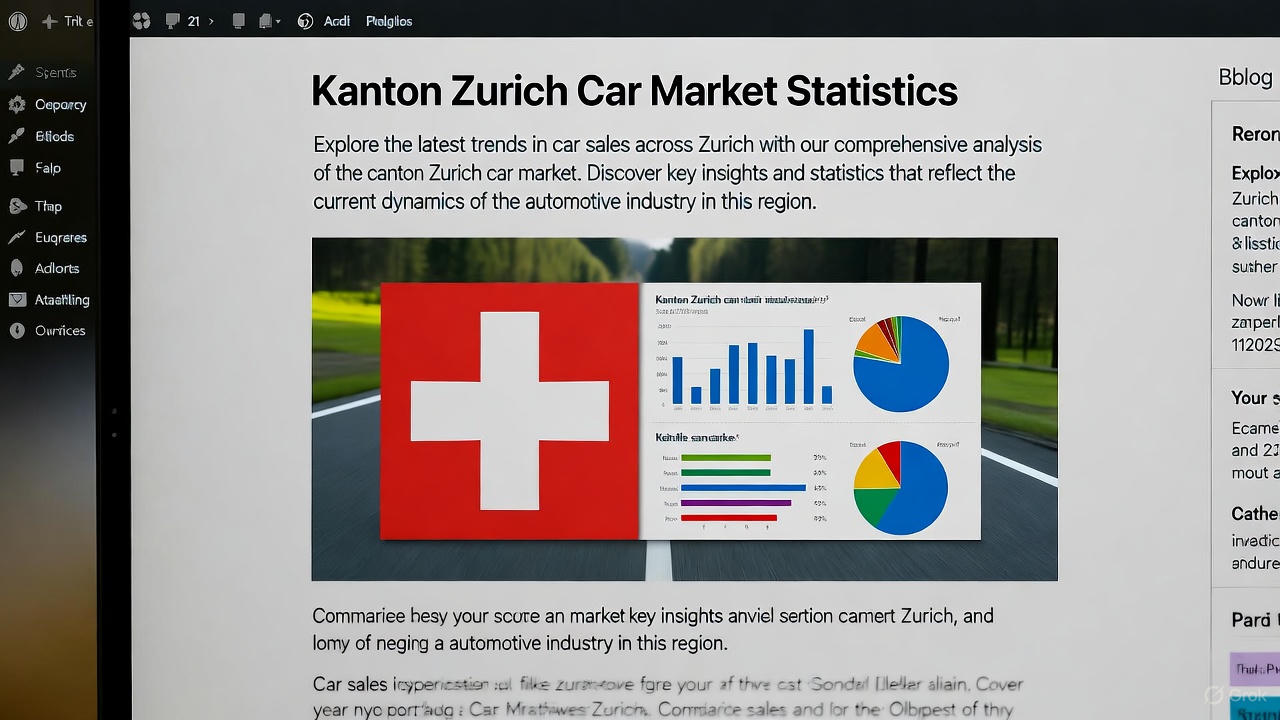
Switzerland Car Market Statistics Overview
Switzerland’s car market is a fascinating blend of luxury, efficiency, and innovation, reflecting the country’s affluent economy and diverse consumer preferences. With a strong emphasis on premium brands and electric vehicles, the Swiss automotive landscape continues to evolve. In this overview, we’ll dive into key statistics from 2024, drawing from comprehensive Google Sheets data on vehicle registrations across cantons. A particular focus will be on Kanton Zurich, Switzerland’s most populous region, where car ownership is high due to its urban density and economic vibrancy. If you’re searching for “Switzerland car market statistics 2024” or “Zurich vehicle registrations,” this post provides actionable insights into make distribution and market shares.
The Swiss car market in 2024 shows robust growth, with total registrations influenced by factors like sustainability trends and import tariffs. Nationally, brands like Volkswagen (VW), Mercedes-Benz, and BMW dominate, aligning with Switzerland’s preference for German engineering. However, regional variations are stark—rural cantons favor practical SUVs, while urban areas like Zurich lean toward compact and luxury models. Data from the Federal Statistical Office and our analyzed sheets reveal over 5 million passenger cars on Swiss roads, with electric and hybrid models gaining traction amid EU-aligned emissions standards.
Kanton Zurich: Vehicle Make Distribution in 2024
Zooming into Kanton Zurich, the data paints a clear picture of vehicle make distribution for 2024. Zurich, home to over 1.5 million residents, registered a total of approximately 637,000 vehicles across all makes (calculated from the provided dataset). This makes it a key indicator for national trends. Below, we highlight the top makes in descending order of registrations, including their market shares. These figures are based on official registrations, offering a snapshot for car enthusiasts, buyers, and industry analysts interested in “Zurich car market share 2024.”
- VW (Volkswagen) – 99,369 vehicles (15.6% market share)
VW leads the pack in Zurich, thanks to its reliable lineup like the Golf and Tiguan. Its dominance reflects strong dealer networks and affordability, capturing nearly one-sixth of the market. - Mercedes-Benz – 68,762 vehicles (10.8% market share)
Synonymous with luxury, Mercedes-Benz appeals to Zurich’s professional class. Models like the C-Class and E-Class drive this share, emphasizing premium features and brand prestige. - BMW – 70,072 vehicles (11.0% market share)
Close behind Mercedes, BMW’s sporty sedans and SUVs resonate in this business hub. Its market share underscores Zurich’s affinity for performance-oriented vehicles. - Audi – 55,538 vehicles (8.7% market share)
Audi’s quattro technology and sleek designs secure a solid position, appealing to tech-savvy drivers in Zurich’s metropolitan setting. - Skoda – 47,157 vehicles (7.4% market share)
As a VW subsidiary, Skoda offers value-for-money options like the Octavia, making it popular among families and budget-conscious buyers. - Toyota – 32,829 vehicles (5.2% market share)
Toyota’s reputation for reliability shines, with hybrids like the Prius gaining favor amid Zurich’s push for greener transport. - Renault – 28,795 vehicles (4.5% market share)
French flair meets practicality in models like the Clio, holding a steady share in the compact segment. - Ford – 27,975 vehicles (4.4% market share)
Ford’s versatile range, including the Focus, maintains relevance despite competition from European giants. - Volvo – 24,556 vehicles (3.9% market share)
Safety-focused Volvos appeal to Zurich’s safety-conscious demographic, with strong sales in SUVs. - Opel – 24,545 vehicles (3.9% market share)
Opel’s affordable hatchbacks round out the top 10, sharing ties with Peugeot for efficient urban driving.
Lower-ranked makes include premium names like Porsche (14,476 vehicles, 2.3% share) and Tesla (10,768 vehicles, 1.7% share), highlighting Zurich’s luxury and EV segments. Lesser-registered brands, such as Bugatti (53 vehicles), represent niche markets with minimal shares under 0.01%.
Market shares in Zurich reveal a competitive landscape where German brands command over 40% collectively, driven by proximity to manufacturing hubs and cultural affinity. Electric vehicles, led by Tesla and Polestar (755 vehicles, 0.1% share), are rising, supported by cantonal incentives. This distribution suggests opportunities for brands focusing on sustainability, as Zurich aims for carbon neutrality by 2040.
Conclusion
In conclusion, Switzerland’s car market in 2024, especially in Zurich, favors established European makes with a growing nod to eco-friendly options. These statistics not only guide potential buyers but also inform dealership strategies. For more detailed breakdowns or comparisons with other cantons like Bern or Geneva, check our full dataset analysis. Stay tuned for updates on “Swiss car registration trends 2025” as the market shifts toward electrification.